
Once you understand the market, competitors, and your target customers (Step 1) and then create your branding guidelines (step 2), the next step is to build a marketing plan that tells you where to create and publish content and how to do it.
The goal of Step 3 is simple:
Put the right message in front of the right people on the channels where they already spend time.
In this step we are creating a gameplan that we can test which will drive potential customers to landing pages, content assets, and other brand information with the goal of moving them down the customer journey into a paying customer that we can help.
Let’s get into this process.
Table of Contents
1- Start With the Customer Journey Funnel & Marketing Channels
Every business needs content for each stage of the customer journey funnel as well as the basic content assets that will establish trust and education on their website.
It helps to think in terms of the customer journey funnel to determine what types of content need to be created.

- Awareness: when your target market is looking for a solution to their problem and you introduce your product or service to them through a digital channel. They become aware.
- Consideration: after your target market is introduced to you they take some time to learn more about your brand and products through informational and trust based content
- Conversion: after your target persona takes some time to learn about you and your products they decide to purchase from you because they believe you can solve their problem
- Retention: after you have a customer you need to keep them in the loop with new products, deals, and create valuable content that will help them gain benefits from repeat use of your products
It’s important to think about what types of content your business is missing or needs to create and where this content will be dispersed in order to reach your target customers.
In this step it helps to use your competitor’s research to determine what types of marketing and content they are creating for these channels and how people are becoming aware of them as well as being educated and converting.
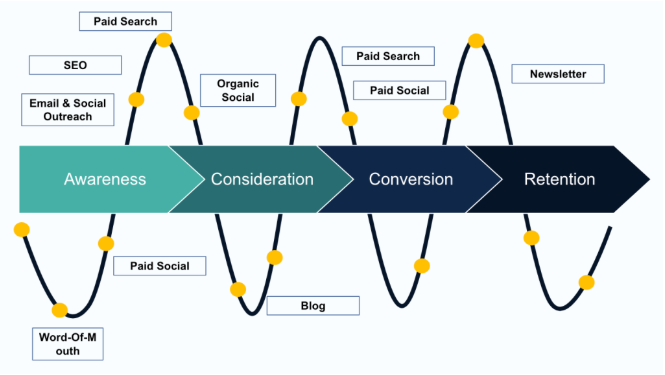
It can also help to input the different marketing channels where your target customers hangout and then think about plotting them on the customer journey graph like the image below.
Think about:
- Have we created all the basic information content that helps people understand us and why we can help them once they become aware of our product? Consideration stage content?
- What are people using to reach target customers? SEO pages? Social Ads? Google Ads? Podcasting? Organic social content? Youtube?
- Do we have the necessary pages and content for our customer funnels once they become aware of us? Landing sales pages? Lead Magnets?
- For our existing customers how do we stay in touch with them? Social posts? Email newsletters?
The basics of coming up with a marketing plan that covers the customer journey include determining and creating content for channels that hit the 4 main phases.
We want to think about a basic content process that will hit each of these phases in a cost effective way.
These phases are:
- Awareness content and channels
- Consideration content assets, email funnels, and pages
- Conversion pages, emails, and ads
- Retention email newsletters and social posts
Marketing Channels
As you think about what types of content need to be created for the different phases of the customer journey it’s also important to think about the different online marketing channels that you can consider to disperse your content on where your customers hangout.
Awareness channels:
Channels that are designed to help people become aware of you.
- Instagram Reels/ TikTok Ads
- Youtube Shorts & Ads
- SEO blogs
- Google search Ads
- Google Business Profile searches (local)
- Facebook posts and Ads
- Partnerships + events
- Podcasting interviews
Consideration Channels:
Educational + Trust Building Resources
- Website pages (about, homepage, product/service pages, info blog posts)
- Long form Youtube content
- Blog posts
- Email newsletters
- Social posts (video, educational, info)
- Testimonials
- Case studies
- Comparison posts
- FAQ content
Conversion Channels:
Designed to turn interest into revenue
- Landing pages
- Sales pages
- Lead magnets
- Retargeting ads
- Sales Email automation sequences
Retention Channels:
Keeping customers, repeat purchases, referrals.
- Email newsletters
- Social content
- Customer only updates
- Events + offers
- Post purchase follow ups
- Reviews + referral prompts
After thinking about these channels, plot them on a graph like the customer journey image above and do some brainstorming on the channels that would be best and the types of content that would fit on those channels.
2- Make a List of The Content Types You Need

After determining a few of the main channels you are going to test from the list above based on your competitor analysis and market insight, make a list of the types of content you need to create both for these channels specifically and to cover those phases of the customer journey.
Some examples include:
Awareness content:
- Short videos for ads
- Hooks for ads
- SEO blog posts
- Organic social content
- Podcast or event interviews
Awareness content is usually short form and meant to grab attention and explain clearly why you have a solution to their problem that they would want to learn more about.
With this type of content we are trying to show them something quickly that will pique their interest and get them excited about a solution to their pain.
Consideration Content:
- Long form Youtube videos
- Testimonials (website or social posts)
- Website about page, home page, service page
- Informational blog posts
- Email newsletters
- Product/service demos
- How to tutorials
- Behind the scenes content
- Expert explainers
In the conversion phase of content you need to make sure that you have informational based text or video content that establishes trust, explains clearly why you can help someone, goes over the steps in the product or service process, explains how your product is different and better compared to others, and more.
The goal is to cover each topic and each part that the customer will be thinking about before they decide to trust and believe that you can solve their problem.
Conversion Content:
- Sales landing pages
- Video retargeting ads
- Offer videos
- Social proof posts
- Sales and discount emails
This type of content is meant to get them to take action and explain clearly why they should take you up on your offer.
Retention Content:
- Value based email newsletters
- Discount and offer email newsletters
- How to get the most from product or service blog posts or videos
- Video social posts
- Image or text based social posts
3- Putting a Plan Together

Even though marketing plans and strategies usually change as you go along testing different types of content and channels you still need to start somewhere and determine the main goals, KPIs, channels, and content types you are going to be focusing on.
Below are the main components that we need to get clear on and put into a plan:
- Goals
- KPIs
- Desired actions
- Target audience
- Target stages in customer lifecycle
- Channels
- Types of content
- Tactics
- Timeline
- Campaign Name
These items can simply be put into a table or spreadsheet where you list the details of each part of the campaign plan.
| Campaign Component | Details |
| Goal | |
| KPIs | |
| Desired Actions | |
| Target Audience | |
| Target Stages in the Lifecycle | |
| Channels and Platforms | |
| Types of Content Needed | |
| Tactic | |
| Timeline | |
| Campaign Name |
Keep in mind that you can use this for one marketing campaign on one channel that you want to focus on or you can use it for a multi channel marketing plan that includes work done on a few different channels.
This really depends on what you determine as the highest priority channel, content, and marketing task that will reach your identified goals fastest. This will also depend on the budget of the campaign and how much someone is willing to invest in marketing activities.
Conclusion
At this point you should have a good idea of the marketing channels you want to focus on for your campaign, what types of content you need to create for those channels, any base content assets that need to be created for your website, and then a concrete set of goals and KPIs to monitor over a set time frame that you will run the campaign.
To get the document that allows you to do all this in one step click here.
