
In this article
So you want to acquire new customers and grow your business.
This will require a solid and comprehensive marketing plan that includes content for different phases of the customer buyer journey so that they become aware of your brand, learn about it, and decide that it will solve their problem.
You can’t just nonchalantly throw up a few different pieces of content on a social profile and expect to attract new customers.
You need a well thought out and smart marketing plan that includes the right content at the right time and in a process that generates a return on your investment and time.
This is where understanding and using the ACCR customer journey marketing funnel comes into play.
In this article, we will outline what this funnel is, what each phase of the customer journey is, and how you can use it to generate a legit marketing plan that will drive new customers and business growth.
The ACCR Marketing Funnel
The ACCR marketing funnel is a customer journey and funnel diagram that consists of a few different phases of the marketing journey each customer moves through when buying from a brand.
A stands for awareness, C stands for consideration, C stands for conversion, and R stands for retention.
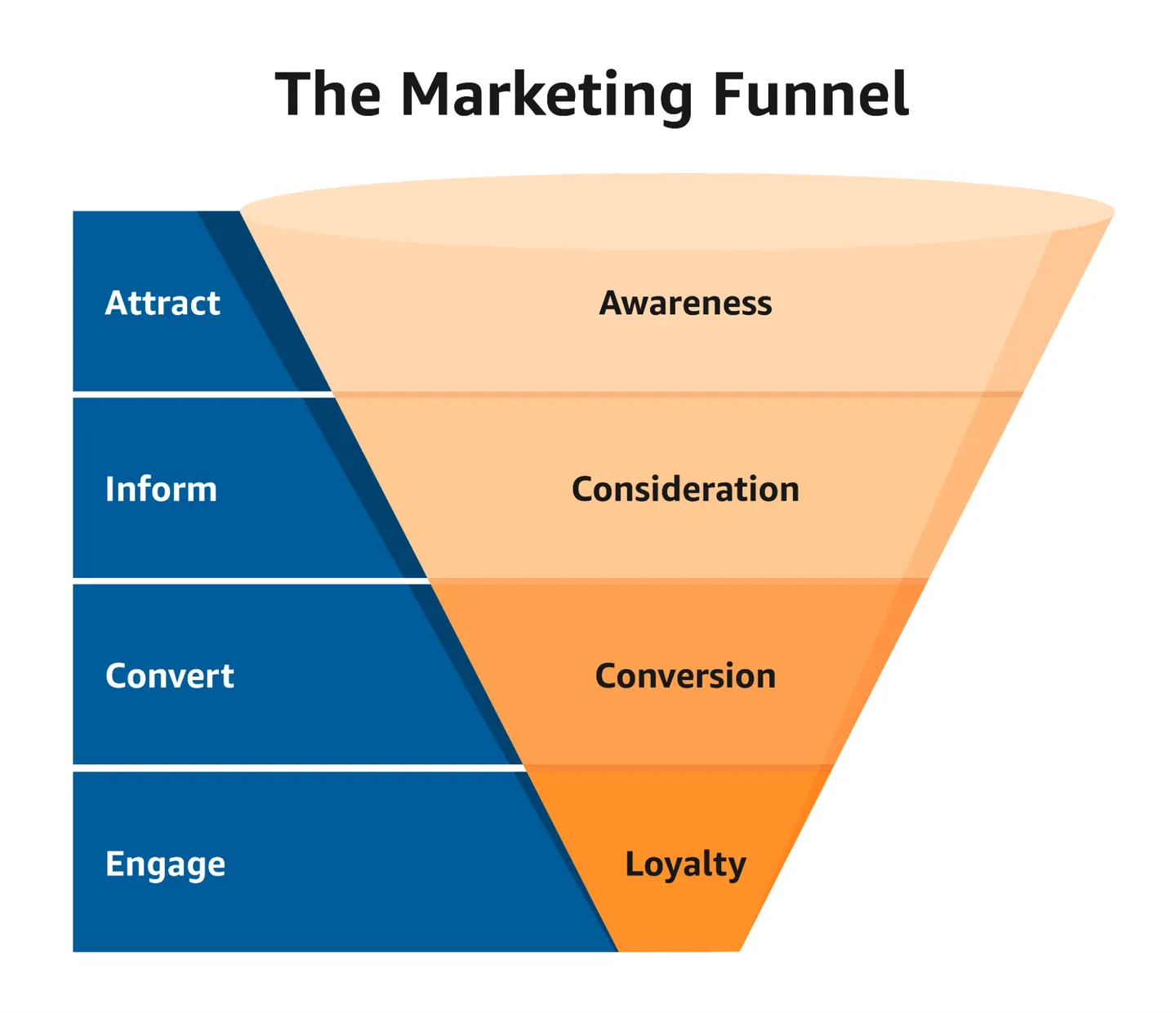
This is an important funnel to understand as a business owner or marketer because each potential customer will go through this funnel on their own whether they do it slow or fast depending on the product and the amount of knowledge they already have before looking for a product.
Content needs to be created for each stage of this funnel so that potential customers in your target market are able to go through each phase of this buyer’s journey.
Here is another example of this customer journey with typical channels placed on it.
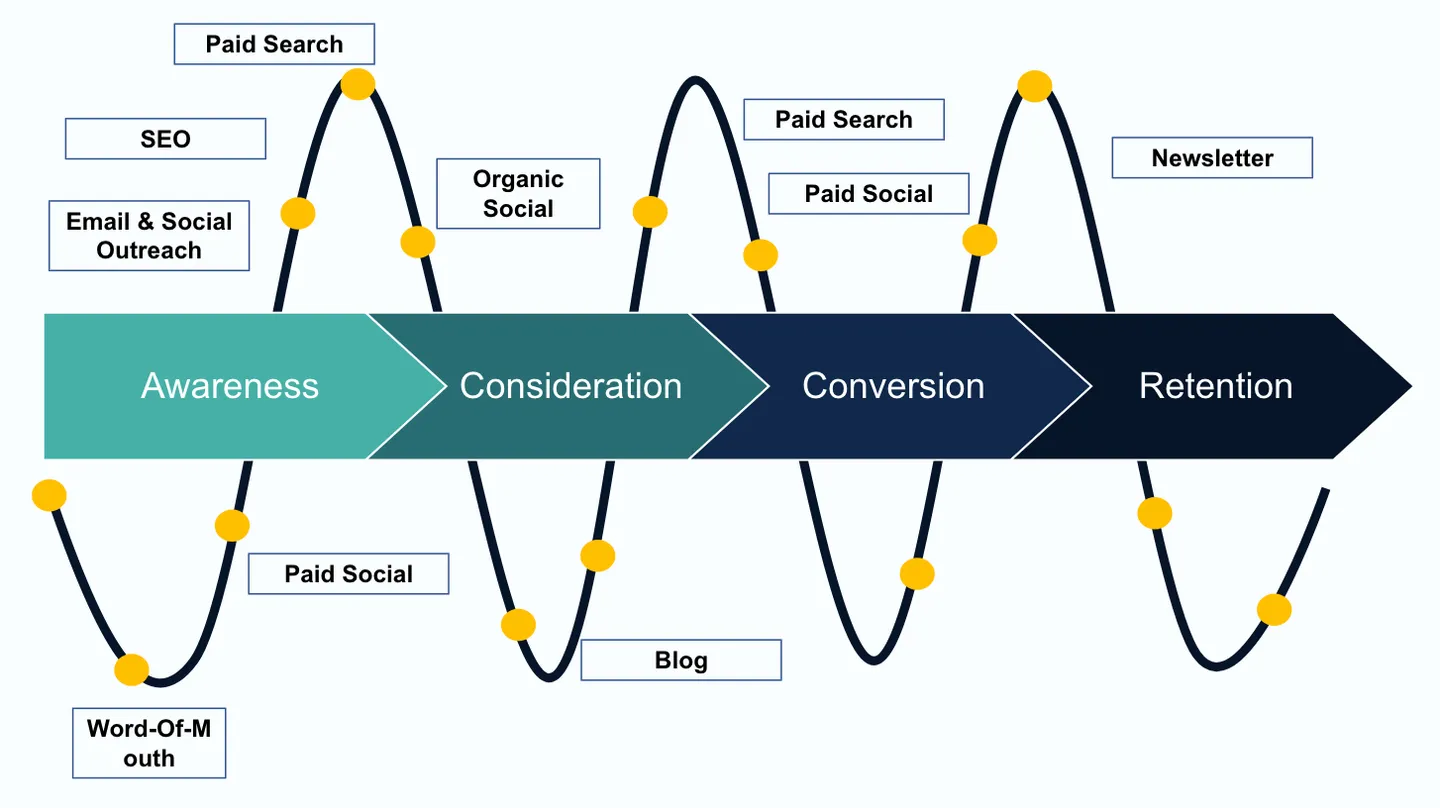
As a marketer the goal is to use this funnel to help design an optimal marketing funnel that includes the necessary content, marketing channels, and investment allocation in order to find and convert potential customers.
Let’s dive into the basics of each phase of this funnel and some channels that fit in with them.
Awareness
This is the first stage of any marketing funnel or customer journey.
It all begins with a target customer persona becoming aware of a product or service that they could benefit from or which solves a specific problem that the person is having.
This stage is about visibility, reach, impressions, and curiosity.
We’re not trying to sell yet — we’re trying to earn attention.
If no one knows about your brand or product it doesn’t even matter if you exist.
At this stage it’s also critical that you have smart and strategic brand messaging that separates you from competitors in the market, carves out a niche, and positions you in the customers mind in a way that separates you from competitors and creates a vivid distinct memory.
Using emotion, a slogan, or a jingle that encapsulates your unique positioning in the market is key at this stage when a customer first hears about you.
Check out the first 5 steps in the 22 immutable laws of marketing to help determine your positioning.
The type of content created in the awareness stage is usually going to be focused on capturing attention, telling someone why you can uniquely solve their problem, and lightly educating them on your offer.
This type of content could exist in the following ways:
- Short social video ads: hooking a target persona by telling them why you can solve their problem and getting them to click through to your website landing page to opt in for a special offer
- Organic Social posts that get shared: Catchy or viral worthy organic social content that highlights your brand or shows how you uniquely solve a problem
- Podcast appearances: doing a podcast episode with another podcaster who speaks to your target audience and mentioning a discount code or landing page
- Word of mouth or organic outreach: Telling people in person about your brand, doing email outreach or social outreach to message others about your product or service and how it solves a problem
- Youtube or Display Ads: Short video display or Youtube ads that hook people and tell them how you solve their problem
- Search informational blog content: creating blog content around keywords that are related to your product or service where people are looking for information or to learn more about this topic
In summary, we need to reach your target market in a cost effective way through a paid or organic digital channel so they become aware of your brand.
The typical types of content for the awareness stage are:
- Quick educational tips or articles
- Pain + problem awareness posts
- Myths, mistakes, “do/don’t” style content
- Short stories, beliefs, mission
- Viral-friendly ideas (hooks, opinions, memes)
- Light case studies or proof snapshots
These types of content are used to catch someone’s attention in your target market and get them to click to your website or landing page to receive more information, sign up for a deal, or opt in to an email funnel.
Once again, in order to gain new customers you simply need to start getting your brand out there and tell them how you solve a specific problem or offer a great product.
Consideration

The consideration phase of the funnel is when someone is already aware of your brand and product and they are going through the process of research.
At this stage you need to get the potential customer to believe that you can solve their problem.
The most important thing in this phase of the marketing funnel is honestly how you initially positioned your product against competition in the market.
If your brand and product was positioned correctly where it serves a specific niche that makes you new or sticks out enough compared to other options then the consideration phase will be shortened as the person just needs to be convinced your product will help them.
On the other hand if you are in a more competitive market or your product doesn’t stand out as much then someone will need to do more research on your brand while comparing you to other brands in the market and be convinced that you are the best option.
In this phase the types of content will typically be informational in nature.
- Informational blog content that someone reads about your brand and products on your website
- Youtube educational videos (embedded on site or shared with links)
- Email nurturing sequences
- Webinars or workshops
- Case study pages or posts
- Social carousel posts
- Retargeting ads with proof + reasons to buy
- Landing pages with comparison and FAQ sections
These types of content will usually contain:
- How to tutorials
- Case studies or before and after stories
- Comparisons of your product vs others
- Objection based content
- Behind the scenes process to develop trust
- Product or service walk throughs
- Testimonials or reviews for social proof
- Data and results
The main problems and questions content in this stage should address are:
- Why should they trust you?
- How are you different from alternatives or competitors?
- How does your product/service actually work?
- Can you solve their specific problem reliably?
- What results or proof can you show?
- What objections or doubts do people have before buying?
In the consideration stage, your audience already knows you exist. Now they’re deciding whether you’re the right choice. Education, proof, comparisons, and handling objections are key. You want them thinking, “These people know what they’re doing. I feel confident choosing them.”
Conversion
At this stage of the funnel potential customers in your target market have become aware of your brand, have done some research on your products, and are now waiting to determine if they really want to pull the trigger or not.
Time and exposure to your brand over time also plays a considerable part in leading to a conversion.
This phase of the marketing funnel is when a more sales-like attitude will come into play.
Something needs to push your potential customer over the line from being interested to pulling out their credit card and making a purchase to try your product.
Usually it’s stronger marketing messages on how you will solve their problem, a sense of urgency or a deadline, and promotional first time offers that will get someone to pull the trigger.
In this stage the content must address:
- Why they should buy now
- The value outweighs the cost
- What results/outcome they can expect
- How the process works (simple + clear)
- Why your solution is the best fit for them
- Reduce risk → remove doubt → increase confidence
The types of channels typically used:
- Sales emails or sequences for people who opted in for a previous offer
- Retargeting ads (social, display, search) that lead to a sales landing page
- Direct message or call based sales process
In this phase of the marketing journey marketers are usually monitoring metrics such as landing page visits, conversion rates, total sales, and using these numbers to look into return on investment.
Retention
The good news at this stage is you have a paying customer! In the conversion phase this person decided to pull the trigger and pay you for your product.
The question marketers and business owners ask now is how can we provide exceptional value and make it so that this new customer wants to keep buying and referring other people to our business.
This clearly needs to start with an awesome product that solves their problem. If you don’t have a great product that solves their problem then your business will eventually fizzle out even with the best marketing on earth.
After your product, what can be done to retain this customer and generate new referral business from them as well?
The key is staying in touch with paying customers and offering them valuable content, notifying them of new products or promotions, and more.
Typical channels that encourage retention are:
- Email newsletters (educational and entertaining on a topic they care about)
- Email flows (Post purchase, onboarding, win back, promotional)
- Nurturing communities (Facebook, Discord, Circle)
- Educational or entertaining content (Youtube videos, organic social posts, blog posts)
- Events
The types of content dispersed on these channels include:
- Onboarding guides and how to get results content
- Post purchase email flows
- Customer spotlight stories
- Tutorials
- Exclusive member only content and deals
- Community driven content
- Educational or entertaining newsletters
Typically in the retention phase of the marketing journey the best ways to interact with and stay engaged with customers are through email and organic social channels where they are following or subscribed.
Overall, the retention stage focuses on everything that happens after someone becomes a customer. This is where brands build loyalty, increase lifetime value, and transform customers into advocates. Content here should help users get results, stay engaged, and feel connected to the brand mission and values. When retention is strong, repeat purchases rise, referrals grow, and the marketing flywheel starts spinning on its own.
Putting It All Together
In order to have a robust and steady business you need a strong and full marketing channel that continues to generate new customers, walks them through the buying process, and engages them to repeat purchases and refer others.
This will consist of a clear understanding of your brand and positioning in the market, a marketing strategy, content creation, and content implementation on different channels in each stage of the marketing funnel.
This also needs to be done with the highest return on investment possible so it will be key to test different marketing channels and types of content, analyze the data after a certain time frame, and continue to optimize and try out new strategies and channels that fit with your overall brand and marketing goals.
If you’re looking for some help getting a marketing plan in order don’t hesitate to reach out!