
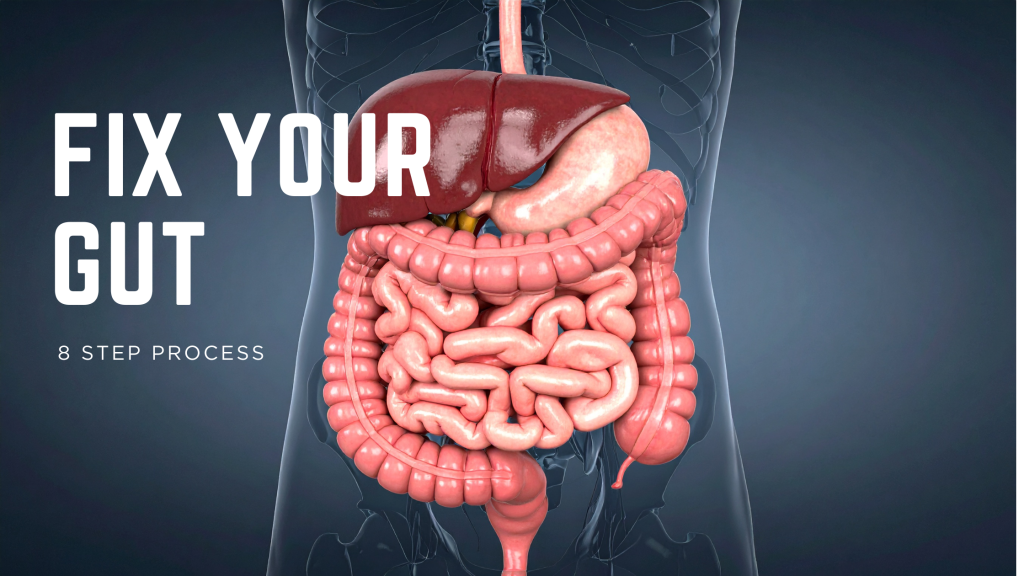
The gut is a major component of our health.
It’s the center for digestion, absorption, and so much more in our body. When we are properly digesting and eliminating food and waste our body naturally runs and feels much better.
As someone who has lived with gut issues throughout my life (at times severe) I have tried many different treatments and protocols.
In this guide, I am going to attempt to simplify the main natural treatment methods that are available and the basics behind them so that when we are in need of a gut reset or repair we can try one of these things to help.
This information is taken from my personal experience, gut health science, and a book called Healthy Gut Healthy You which goes over a simple gut healing protocol that we can follow.
Table of Contents
- 1 8 Step Gut Health Action Plan
- 2 1- Reset- Reset Your Diet And Lifestyle
- 3 2- Support- Support Your Gut With Probiotics And Digestive Enzymes
- 4 3- Remove- Remove Or Reduce Unwanted Bacteria With Antimicrobial Herbs
- 5 4- Rebalance- Rebalance Gut Bacteria After Treatment With Antimicrobials
- 6 5- Reintroduce- Reintroduce Foods You Removed In Step 3
- 7 6- Feed- Feed The Good Bacteria
- 8 7- Wean- Wean Yourself Off The Supplements In Your Plan
- 9 8- Maintenance And Fun Enjoying Life
8 Step Gut Health Action Plan
Below is an outline of the basic steps in the gut healing process.
The Steps:
- Reset diet and lifestyle– Clean up your diet and consider doing a brief fast with liquid nutrition
- Support– support your gut with probiotics, enzymes, and adrenal support
- Remove– reduce unwanted gut bacteria with antimicrobial herbs or elemental diet
- Rebalance– rebalance gut bacteria after antimicrobial treatment with prokinetics
- Reintroduce– reintroduce foods you removed in step 1 and work to broaden a healthy diet
- Feed– feed the good bacteria with prebiotics and fiber or determine how much you can tolerate
- Wean– wean off the supplements in your plan to find the minimum effective doses
- Maintenance and fun– maintain your improvements and enjoy your life
Rules for the 8 steps:
- If after step 1 or 2 symptoms have improved enough where you are satisfied, move to step 5
- If you don’t feel better after steps 1 and 2, go to step 3 and proceed
- If you perform step 3 it’s helpful to also perform step 4. Step 3 and 4 go together
- Whether you have completed step 1, steps 1 and 2, or steps 1-4, you should complete steps 5-8
1- Reset- Reset Your Diet And Lifestyle

In this step of the protocol there is a modified fast and then a change to a healthy diet.
Step 1A: Modified Fast
The fast should be performed for 2-4 days.
On the first day not everyone feels better but by the second day you should usually notice some improvements.
If someone feels tired, hungry, or has a negative reaction to the fast then they can discontinue and move on to the whole foods diet step.
The options for the modified fast are:
- Bone broth or chicken soup (with just vegetables and chicken)
- Elemental diet formulation (absorb plus or elemental heal)
For more detailed information on the modified fast see this document.
Step 1B: Finding the Ideal Diet
Next in this step of the protocol is cleaning up your diet and finding the best diet for your body.
If you noticed you felt better on the fast then a diet that skips meals or feeds less frequently may be better for you.
If you did not feel good on the fast or you get tired, irritable, or jittery when you miss meals you should eat regular meal times and consider maybe adding one snack into your diet.
Meal frequency is an important component of diet since it helps to control blood sugar.
Most Important Aspects of Diet
Below are the most important aspects in any healthy diet:
- Low in allergens and intolerances that cause inflammation
- Contains the proper amount of bacterial fermentation for you (prebiotics and FODMAPs)
- Regulates blood sugar and contains the right ratio of carbs to protein/fat
- Contains fresh whole unprocessed foods
- Focuses on organic and local foods
A few diets that contain these principles which you can start with and modify based on your own body are the following:
Whole 30 Diet and Elimination Phase
What you can eat on the Whole 30:
- Meat
- Seafood
- Eggs
- Vegetables
- Fruit
- Animal and plant based fats
- Herbs, spices, seasonings
What to Avoid for 30 days:
- Added sugars
- Alcohol
- Grains
- Legumes
- Dairy
- Baked Goods
The whole 30 eliminates these foods for 30 days and then reintroduces them for 1 day 1 item at a time to determine how they impact your body and if you can add them back in.
See this handout or visit the Whole 30 site for instructions and foods.
The Paleo Diet
What you can eat on the paleo diet:
- Meat
- Seafood
- Eggs
- Poultry
- Fruits
- Vegetables including potatoes
- Healthy oils
- Nuts and seeds
What you should avoid on the paleo:
- Grains
- Legumes
- Refined sugar
- Processed foods
- Refined vegetable oils
See this page for more information on the paleo diet.
Low FODMAP Diet
Foods to AVOID (High FODMAP)
- Fruits: Apples, pears, watermelon, mangoes, cherries, peaches, apricots, plums, avocados.
- Vegetables: Onions, garlic, leeks, broccoli, cauliflower, mushrooms, artichokes, asparagus, cabbage.
- Legumes: Beans, lentils, chickpeas, soybeans.
- Dairy: Milk, yogurt, custard (unless lactose-free).
- Grains/Breads: Wheat, rye, barley, most regular bread, pasta.
- Nuts/Seeds: Cashews, pistachios.
- Sweeteners: Honey, high-fructose corn syrup, agave, sugar alcohols (sorbitol, xylitol).
Foods to EAT (Low FODMAP)
- Proteins: Plain meat, poultry, fish, eggs, firm tofu, tempeh.
- Dairy: Lactose-free milk/yogurt, hard cheeses (cheddar, parmesan).
- Vegetables: Carrots, potatoes, spinach, bell peppers, zucchini, green beans, lettuce, eggplant.
- Fruits: Grapes, strawberries, blueberries, oranges, kiwi, cantaloupe, unripe bananas, pineapple (limited).
- Grains: Rice, quinoa, oats (small amounts), corn, gluten-free breads/pasta.
- Nuts/Seeds: Peanuts, macadamia nuts, walnuts, pumpkin seeds, chia seeds.
- Sweeteners: Maple syrup, brown sugar, rice malt syrup, table sugar.
The most important aspect of any of these diets is cleaning up the types of carbohydrates you consume as well as the quality and type of foods you are eating from processed foods to whole real foods.
The main foods that can trigger inflammation or cause issues in people are usually dairy, refined sugar, gluten and grains, sometimes eggs, alcohol, and legumes.
2- Support- Support Your Gut With Probiotics And Digestive Enzymes

These are the supplements that are best to implement once your diet is in place to monitor if they help or not and if you should continue using them.
2A-Probiotics
| Name | Dose | Times/Day | w/Food | Product |
| Lacto Bifido blend | 2 pills or 50-100b cfu | 1-2 | N | Product Type |
| Saccharomyces Boulardii | 300-600mg | 1-2 | N | Product Type |
| Soil Based Probiotic | 1 cap | 1-2 | Y | Product Type |
Probiotics can have antibacterial, antiinflammatory, and prokinetic effects on the gut. When introducing probiotics it’s usually best to test one at a time for a few days to a week to make sure they don’t cause negative reactions.
In some cases probiotics can cause bloating and brain fog and if this is the case if those symptoms stick around after a week or more then it’s best to discontinue and proceed with the process.
2B-Digestive Enzymes
Digestive enzymes help to break down food and prevent some of the bloating and gas production that bacteria can produce in the gut.
You simply just take 1 capsule with food each time you eat and they can help a lot with digestion and absorption of nutrients.
| Name | Dose | Time | w/Food | Product |
| Digestive Enzymes | 1-2 caps w food | With meals | yes | Product Type |
2C-Adrenal & Hormone Support
Adrenal support helps to mitigate stress and aid in resilience in the nervous system which can help create a healthier gut and body ecosystem.
| Name | Dose | Times/Day | w/Food | Product |
| Adrenal Support Complete | 2 pills | 1-2 | NA | Product Type Herbal Product |
3- Remove- Remove Or Reduce Unwanted Bacteria With Antimicrobial Herbs

In this step we are working on treating and changing some of the microbial balances in your GI tract that could be contributing to gas, bloating, diarrhea, constipation, and other symptoms.
During this step you will continue on the diet and support supplements including probiotics which have been shown to help with antimicrobial activity.
This is a 2 month process.
Month 1 Protocol
| Name | Dose | Times/Day | w/Food | Bottles | Product |
| Biota clear 1a | 3 pills | 2x day | Best w/o | 2 | Product Type |
| Biota clear 1b | 2 pills | 2x day | Best w/o | 2 | Product Type |
Month 2 Protocol
| Name | Dose | Times/Day | w/Food | Bottles | Product |
| Biota clear 2a | 2 pills | 2x day | Best w/o | 2 | Product Type |
| Biota clear 2b | 3 pills | 2x day | Best w/o | 2 | Product Type |
*One other thing to note is that if you are experiencing constipation taking some magnesium citrate or another form of magnesium can aid in this issue during the protocols or anytime.
Lastly, when using antimicrobials it is common to experience some die off like effects for a few days to 1 week. They usually subside after a few days. If it’s the case that you are having persistent symptoms that could represent an allergy or a negative reaction to a product then stop and try just using one of them.
Other products that you can consider if you have a negative reaction to the above mentioned products are:
- Berberine HCL 500mg- 4 caps 3x a day
- Atrantil- 2-4 caps 2x day
- Garlic extract garlic select- 2 caps 2x per day
- Oregano Oil
At the end of 2 months and this step of the process take time to reassess where you are at. If you are feeling better, move to step 4. If not, consider the elemental diet on a longer term basis.
4- Rebalance- Rebalance Gut Bacteria After Treatment With Antimicrobials
At this point you will most likely have completed a 2 month or more antimicrobial protocol where your gut ecosystem was shifted a bit to remove overgrowths and unnecessary bugs.
In this step it’s important to keep the same diet, support, and lifestyle system in place.
We will now add something called a prokinetic agent which helps the function and movement of the gut.
Motility Support Supplement
| Name | Dose | Times/day | w/Food | Notes | Product |
| Motility Support | 4-6 caps | Once before bed | No | Can also dose 2 cap 3x per day between meals | Product Type Product Type Product Type |
| Iberogast | 60 drops | Before bed | No | 20 drops 3x per day between meals is an option | Product Type |
A motility support supplement can be taken for 1-3 months before evaluating how things are going after being on it for a while and discontinuing antimicrobials.
To see other recommended motility products check out this page.
Relapse and Assessment
During this step of the process after moving through the antimicrobial or gut balancing process and then implementing a prokinetic agent things will either stick or they will start to regress back to your original problematic symptoms.
If it’s the case that you regress it may mean you need another antimicrobial protocol or to find a low dose cyclic antimicrobial plan for the longer term or a semi elemental diet plan for the longer term to manage a stubborn or more chronic issue.
5- Reintroduce- Reintroduce Foods You Removed In Step 3
At this step there is a good chance after spending some time rebalancing your gut that you will be able to broaden your diet and reintroduce a wider array of foods.
The key when implementing this step is having somewhat of a stable base in your symptoms and diet so that we can determine which foods to bring back in and which ones it might be best to stay off of.
These are the main types of foods you will most likely be reintroducing:
- Dairy
- Sugars
- High FODMAP foods
- Grains/Gluten
- Starchy vegetables
- Eggs
- Soy
This is the basic process and principles to follow when doing reintroduction:
- Reintroduce the most restrictive foods first
- Reintroduce foods one at a time
- Have a few serving a day for a few days to determine (enough quantity)
- The more severe your intolerance the more obvious it will be
- Over time you can revisit introducing more foods since as the gut heals you can tolerate more
The other thing to determine is how much carbohydrates you ideally want in your diet. Finding the right amount of carbs generally for your body is going to be an important finding in diet.
Another really important thing to consider is not to become afraid of food or even things that cause reactions. If you find you do better eating less of something or cutting it out then by all means do it but just remember that anxiety about food can also cause reactions and this can lead to a vicious cycle of developing an eating disorder.
Our goal with this step is to find the right diet for your body and lifestyle which allows you to stay healthy while also enjoying social activities. This could mean that you eat your healthy diet 5 days a week and allow for a couple of days where you don’t monitor your diet or food reactions as much.
6- Feed- Feed The Good Bacteria
6A-Fiber
Fiber and prebiotics can help maintain a healthy gut ecosystem by feeding the balance of bacteria you have in your gut.
There are a few main types of fiber products:
| Name | Dose | Times/day | w/Food | Note | Product |
| 1-Biota Fiber | 1-2 T | 1-2 | N | General fiber-3g soluble 1g insoluble | Product Type |
| 2- Heather’s Tummy Fiber or Citrucel | 1-2 T | 1-2 | N | Low FODMAP soluble | Product Type |
| 3- Psyllium | 1-2 T | 1-2 | N | Low FODMAP partially soluble | Product Type |
The following are the guidelines for fiber supplementation and experimentation:
- Slowly introduce and build up to the recommended dose over 1-2 weeks
- If you don’t react well to one fiber discontinue and try the next one
- Find one fiber that works and then move to prebiotics. You only need 1 fiber
- If you don’t do well with fiber move on to prebiotics
6B-Prebiotics
After fiber experimentation we can introduce prebiotics to see if there is one we can tolerate. Prebiotics can aid in cultivating healthy bacterial species and an ecosystem in the gut.
Below are a couple of prebiotics and instructions below.
| Name | Dose | Times/day | w/Food | Notes | Product |
| Biota Boost Prebiotic | 1-3 caps | 1-2x day | either | Slowly build to dose over 2 weeks. Can cause some bloating/gas at first | Product Type |
- Take one to 3 caps per day 1-2x per day
- Take with water
- Slowly build up dose
- If you are not feeling worse you can move on to resistant starch
- If you have a reaction discontinue and proceed to try resistant starch
| Name | Dose | Times/day | w/Food | Notes | Product |
| Unmodified tapioca starch, green banan | 1 t | 1-2x | N | Slowly build to dose over 2 weeks. Can cause some bloating/gas at first | Product Type Product Type |
- 1 tsp 1-2x per day
- Slowly build up
- If it’s fine move to next step
- If have reaction discontinue and move on
After testing different types of fiber and prebiotics determine if they are helping you or not. If not, you can discontinue and move on. If they are, keep them in.
7- Wean- Wean Yourself Off The Supplements In Your Plan
In this step we are working to find the minimum effective dose for any supplements you are taking and to wean off any that are not needed.
Which supplements come off first?
- Adrenal support
- Prokinetic
- Low dose cyclical antimicrobial
- Fiber and prebiotics
- Hybrid use of elemental diet
- Digestive enzymes
- Probiotics
In this step you are simply testing coming off one thing at a time to determine if you can go without it or if it is still helping you enough to continue.
8- Maintenance And Fun Enjoying Life
At this point you have been through all the steps necessary for your own body and gut and should have at least a baseline improvement of your gut health and some consistency in your plan.
It’s not time to enjoy your life and try to maintain your baseline level of health that you experienced.
Keep in mind that it’s normal to have setbacks and fluctuations in your gut and overall health. The key is developing consistent habits where you can move away from them and have fun in your life but then return to your baseline health protocols.
