
After market research has been done for a business and you have a good idea where the business should be positioned in the market the next step is to turn that positioning into a clear and well communicated brand that you can use for all your marketing content creation.
Branding is a really important component of business because it enables a business to stick out in the minds of customers, charge higher prices, and speed up the recognition and relatability of a business.
Branding can be the difference between business success and failure in a market and provide a competitive advantage.
Let’s get into the basics.
Table of Contents
1- Branding Foundations
There are a few branding foundations that need to be outlined and in place for your business.
1- Mission Statement
You need to be clear on why your business exists and what the mission is of your business.
This should be in one clear sentence that includes:
- Who you serve
- What problem you solve
- Why it matters
An example format would be “We help [who] achieve [outcome] by [how], so they can [bigger result].”
2- Value Proposition
A value proposition is basically what makes you stand out from competitors and is related to the positioning you are taking in the market.
For the value proposition it’s best to focus on:
- Primary benefit
- Key differentiator
- Ideal customer pain point
A simple framework for this would be “Unlike [alternative], we provide [unique value] for [specific audience].”
2- Brand Voice and Emotional Identity
Once you have your mission and value proposition down the next key step is getting your brand voice and emotions clear so that when you communicate through text or speech you are able to stay on brand and connect to your target audience.
1- Brand Personality & Tone
It’s important to define 3-5 core traits that represent your brand.
For example, warm, friendly, bold, calm, trendy, provocative, hip, adventurous.
It’s also helpful to think about how the brand will sound in emails, social media copy, website copy, and sales pages.
2- Emotional Positioning
Next, it’s important to think about how you want people to feel when interacting with your brand.
Common emotional goals include:
- Trust
- Safety
- Confidence
- Hope
- Empowerment
Emotion drives conversions and sales much more than logic does as most people are generally seeking an emotional state or goal instead of purely a rational reason for buying products.
3- Brand Visual Identity
Besides your brand voice and emotional identity there is also a very important visual identity in each brand.
This consists of a few components.
1- Color Palette
- 1 primary color
- 1-2 secondary colors
- 1 background color
- These colors should reinforce the emotion and positioning
2- Fonts & Typography
- Headline font
- Body font
- Keep it simple and consistent
3- Logo Basics
- Clean, scalable, recognizable
- Works in black and white, small sizes, digital and print
- It supports and works with the brand
Creating a Brand Style Guide
In order to put all these brand elements together into one file or package that can be used to create content we need to create a brand style guide.
This guide is important because you can give it to anyone who is working for your company or helping create brand assets to keep things on brand.
The style guide will contain all the brand elements including:
- Mission Statement
- Value Proposition
- Brand voice traits
- Emotions
- Colors
- Fonts
- Logo basics
Below is a simple example of a brand guidelines sheet.
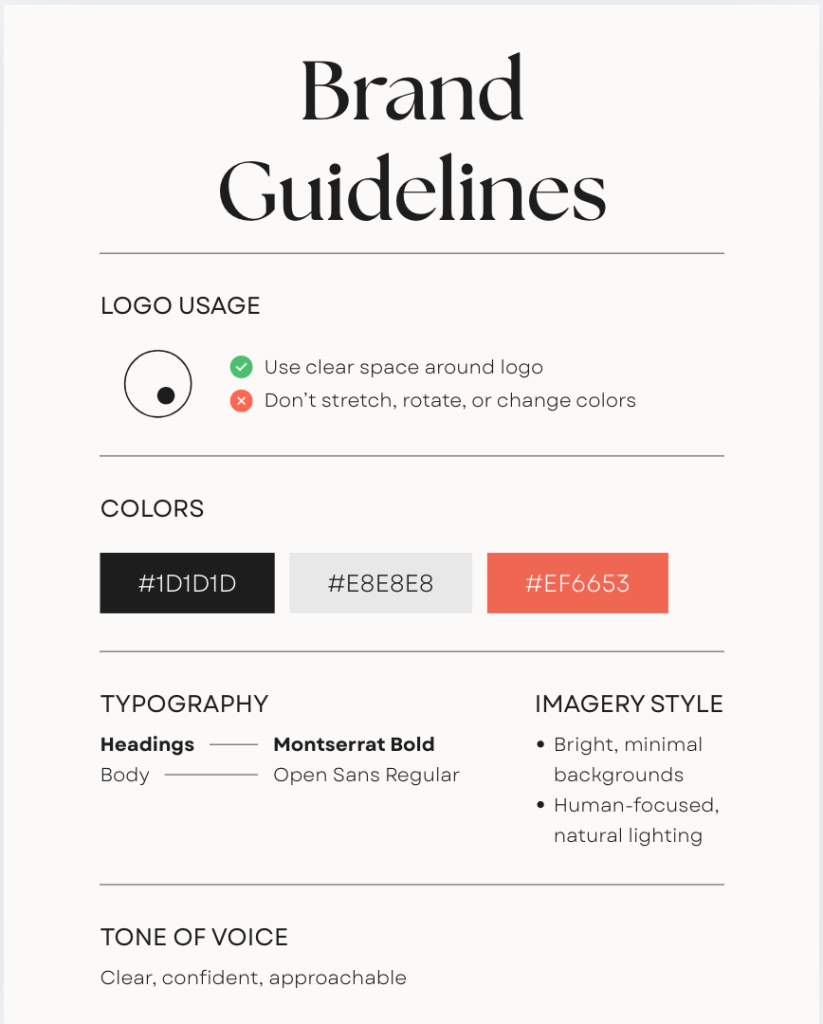
You can simply use a Canva template to create this brand style guide or another template online that allows you to plug in all the details you got clear on beforehand.
Putting it All Together
In this step of the marketing process we’ve gone over all the branding basics that need to be outlined and clarified so that you can create a brand that is positioned in the market correctly and where the content is able to be kept on brand.
For a simple template you can fill out for this process click here.
Next in the marketing process is choosing the right channels, creating a plan, and getting started on content creation.
